Every summer, foundation problems that stayed quiet all winter suddenly show up. In BC’s Interior, hot, dry weather pulls moisture out of the ground, and moisture-sensitive clay and silt soils shrink as they dry. When that shrinkage happens unevenly beneath a building, the foundation can settle — and that is when new cracks, sticking doors, and sloping floors tend to appear, often between July and September. Most of these signs are cosmetic. Some are the first warning of active structural movement that deserves a professional look.
Here is how to tell the difference, and what to do about it.
Why do foundation cracks appear in the summer?
Soil is not a fixed, solid thing — it expands when it takes on water and contracts when it dries out. The Interior’s semi-arid climate makes this cycle especially pronounced. Long stretches of hot, dry weather in and around Kamloops and the Okanagan draw moisture out of the upper soil, and clay-rich or silty soils lose volume as they dry.
When the soil under one part of a foundation dries and shrinks more than the soil under another part, the foundation is no longer evenly supported. That uneven, or differential, movement is what stresses concrete and framing — and it is why a crack you never noticed before can open up in the middle of summer. Mature trees close to a home can make it worse, because their roots pull large volumes of water out of the soil during the growing season.
Which Interior soils are most affected?
Not every property is equally at risk. Much of BC’s Interior sits on glacial and post-glacial deposits, and the behaviour of your soil depends on what is under your home:
- Silts and clays — the most moisture-sensitive. These soils shrink and swell with the seasons and are the usual culprits behind seasonal foundation movement.
- Sands and gravels — drain freely and change volume far less, so they are generally more stable through dry spells.
- Glacial till and bedrock — often provide a strong, stable bearing layer where they are present.
Because these deposits can change over a short distance, two neighbouring homes can behave very differently. Understanding what is actually beneath a foundation is the job of a geotechnical assessment, and it is the starting point for any real diagnosis.
Cosmetic or structural? How to read a crack
Not every crack is a cause for alarm. Concrete naturally develops fine cracks as it cures, and many hairline cracks never lead to anything. The pattern, width, and behaviour of a crack tell you far more than the fact that it exists.
Usually cosmetic:
- Fine, hairline cracks in a concrete wall or slab, especially thin vertical ones.
- Small cracks that appear once and do not change over the seasons.
Worth a professional assessment:
- Stair-step cracks running diagonally through concrete block or brick.
- Horizontal cracks in a foundation wall.
- Cracks wider than about 3 mm (⅛″), or cracks that are visibly widening over weeks or months.
- Cracks where one side has shifted out of line with the other.
- Doors and windows that suddenly stick, or visible gaps opening at their corners.
- Sloping or uneven floors, or gaps appearing between walls, floors, and trim.
A single hairline crack is rarely an emergency. Several of these signs appearing together — or one that keeps growing — points to ongoing movement that is worth investigating before it gets worse.
When should you call a foundation engineer?
The key question is not “is there a crack?” but “is the building still moving?” Movement that is active and progressive is what causes real damage over time. It is time to bring in a professional engineer when you see:
- A crack that is measurably growing, or new cracks appearing over a single season.
- More than one of the warning signs above at the same time.
- Any horizontal foundation crack, or a wall that appears to be bowing or leaning.
- Doors, windows, or floors that are getting noticeably worse.
An engineer can determine whether the movement is active, what is driving it, and whether it needs to be stabilized — or simply monitored. Catching it early almost always means a simpler, less costly fix.
How are settlement problems fixed?
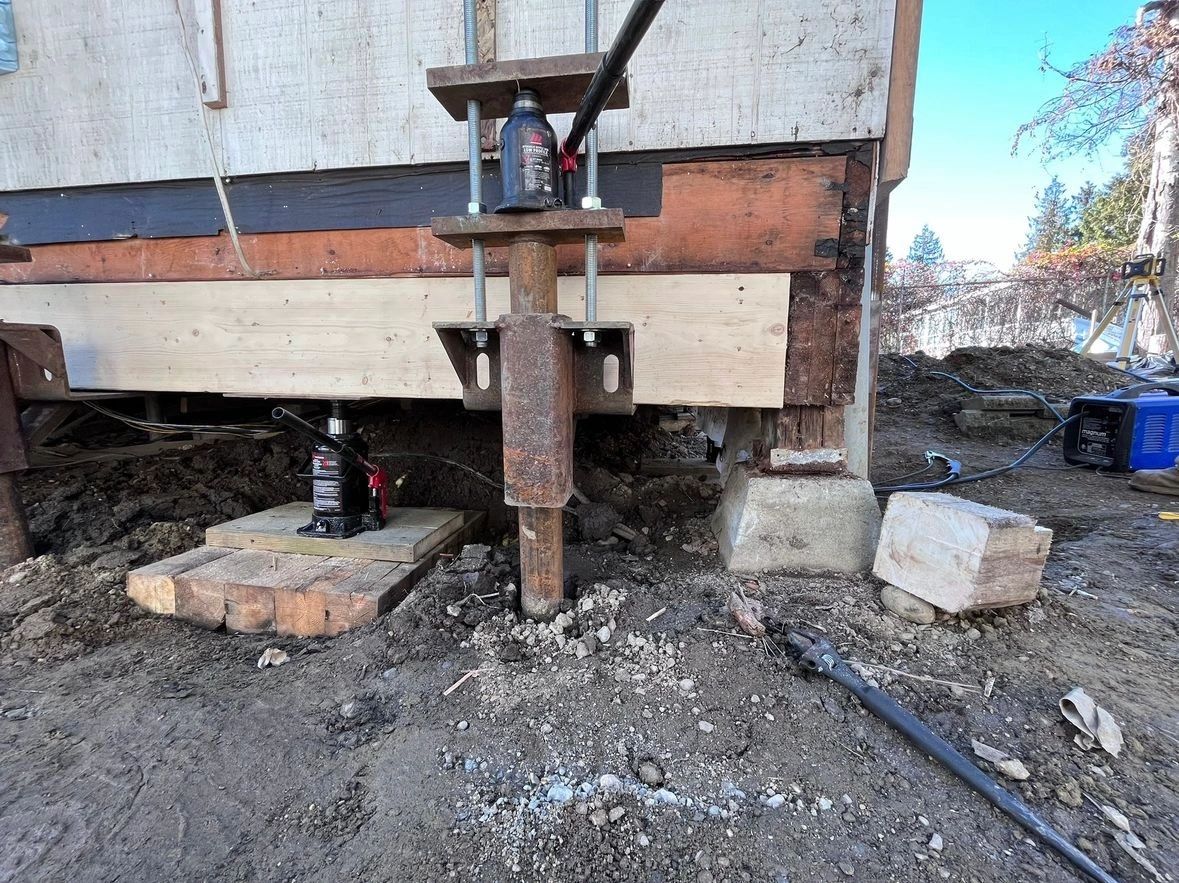
When a foundation has settled because the soil beneath it can no longer support it reliably, the solution is to transfer the building’s weight down to soil or rock that can. That is the idea behind underpinning. (Our guide to foundation repair in BC walks through each of the main repair methods and what the process involves.)
It starts with an assessment: understanding the soil profile and the cause of the movement. From there, a common engineered solution is to install helical piles or micropiles beneath the foundation. These steel piles are advanced through the unstable upper soils and into a stronger bearing layer below, then connected to the existing foundation so the load bypasses the problem soil entirely. Helical piles can often be installed with compact equipment and relatively little disruption to the site, which matters on established residential properties.
The right approach depends entirely on your soil and your structure — which is exactly why the engineering assessment comes first.
What you can do this summer
If you have noticed a crack or a sticking door, a few simple steps help:
- Track it. Mark the ends of a crack with a pencil and note the date, or take a dated photo. Whether it moves over the next few weeks is the most useful information you can gather.
- Keep soil moisture consistent. Sudden swings — a bone-dry summer followed by heavy watering right against the foundation — can make seasonal movement worse. Even, well-drained moisture is the goal.
- Don’t ignore progressive movement. A crack that keeps growing will not fix itself, and early attention is almost always the less expensive path.
If the signs point to active movement, an engineered assessment will tell you exactly what you are dealing with. At BC Foundations, our team specializes in diagnosing and solving foundation problems on the Interior’s challenging soils — from Kamloops through the Okanagan. Contact us today to arrange a foundation assessment.
Frequently asked questions
Are foundation cracks always serious?
No. Many hairline cracks are cosmetic, especially thin vertical ones in concrete. The cracks worth a professional assessment are horizontal cracks, stair-step cracks in block or brick, cracks wider than about 3 mm, and any crack that is actively widening.
Why do my doors start sticking in the summer?
Doors and windows that suddenly stick or won’t latch are often a sign that the frame around them has shifted — which can happen when soil dries and the foundation settles unevenly. If it comes and goes gently with the seasons it may be minor; if it is getting steadily worse, it is worth having checked.
Does watering the ground around my foundation help?
The goal is consistent soil moisture, not extremes. Large swings between very dry and very wet soil against a foundation can worsen seasonal movement. Good, even drainage matters more than heavy watering.
How much does foundation repair cost?
It depends on the cause, the depth to stable soil, the number of piles required, and site access, so there is no single figure. Every project starts with an assessment that identifies the problem and scopes the fix.